Emotional Regulation + Story Predictability: Why Personalized Books Are a Parent’s Best Friend
Start a cover preview
We’ve all been there. It’s 7:00 PM, and your child is having a complete meltdown because their favorite blue cup is in the dishwasher, or perhaps they are feeling anxious about a doctor’s appointment the next morning. These "big feelings" are a natural part of growing up, but they can be exhausting for both you and your little one. As parents, we are constantly looking for tools to help our children navigate these emotional waves. One of the most effective, yet often overlooked, tools is the combination of emotional regulation + story predictability. When children know what to expect in a story—especially one where they are the hero—it creates a sense of safety that allows them to process complex emotions more effectively.
The Science Behind Emotional Regulation + Story Predictability
To understand why this works, we have to look at how a child’s brain develops. The part of the brain responsible for logic and "calming down"—the prefrontal cortex—is still under construction well into young adulthood. Meanwhile, the amygdala, which handles the "fight or flight" response, is fully active from a very young age. This is why a toddler can’t simply "reason" their way out of a tantrum.
When we introduce emotional regulation + story predictability through reading, we are essentially giving the brain a map. Predictability lowers the brain's alert system. If a child knows exactly what is going to happen on the next page, their nervous system relaxes. They aren't worried about a sudden scary monster or a sad ending. This relaxed state is the perfect "learning zone" for emotional regulation. In this state, they can observe how a character (or better yet, themselves) handles a difficult situation without feeling the actual stress of that situation.
Think of it like a flight simulator for pilots. A pilot practices an engine failure in a simulator so that if it happens in real life, they know exactly what to do. Predictable stories act as an emotional simulator for your child. By building a consistent bedtime routine, you provide a stable environment where your child feels safe enough to explore these big concepts.
How Personalization Changes the Emotional Equation
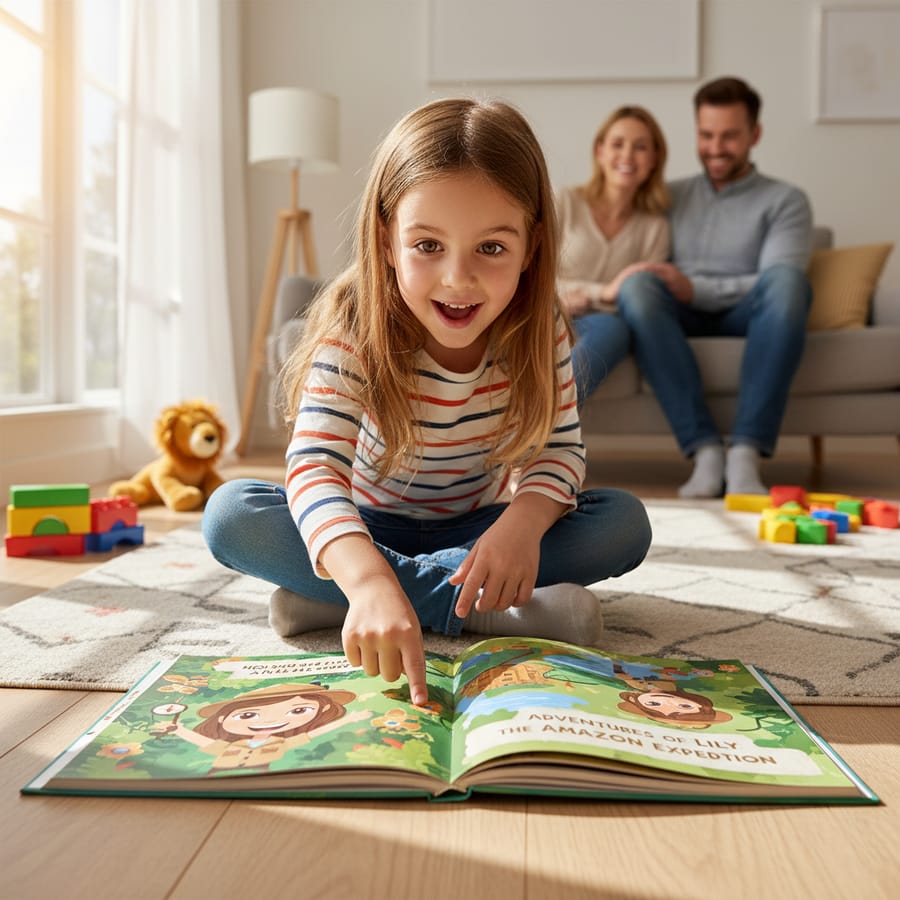
Traditional books are wonderful, but personalized books take the benefits to a whole new level. At StorytimeHero.ai, we use AI to place your child’s uploaded photo into the illustrations. This isn't just a "cool feature"—it has a profound psychological impact.
When a child sees themselves as the hero of the story, their "mirror neurons" fire more intensely. They aren't just watching a generic character solve a problem; they are watching themselves solve it. This creates a powerful sense of self-efficacy. If "Storybook Leo" can take a deep breath when he’s frustrated, "Real-Life Leo" realizes he can do it too.
Personalization bridges the gap between fiction and reality. It makes the lessons in emotional regulation + story predictability feel personal and achievable. When the story is predictable, the child feels safe. When the story is personalized, the child feels empowered.
Building Resilience Through Emotional Regulation + Story Predictability
Resilience is the ability to bounce back from challenges. It is a skill that must be practiced. We often think of resilience as something that happens during a crisis, but it is actually built during the quiet moments of the day.
Using emotional regulation + story predictability helps build this muscle by allowing children to "preview" challenges. For example, if your child is nervous about starting kindergarten, a predictable story where they are the hero navigating the first day of school can be life-changing.
Here is how predictability builds resilience:
- Reduced Cognitive Load: Because the child knows the plot, they can focus entirely on the emotional cues and coping strategies presented in the book.
- Pattern Recognition: They begin to see that "Problem A" leads to "Feeling B," which can be solved by "Action C."
- Validation: Seeing themselves face a challenge in a book validates that it is okay to feel scared or frustrated.
By using personalized children's stories, you are giving them a visual and narrative blueprint for success. They see their own face smiling as they make a new friend or try a new food, which reinforces the idea that they are capable of handling new experiences.
The Power of Seeing Themselves: Emotional Regulation + Story Predictability in Action
Let’s look at a real-world scenario. Imagine your daughter, Maya, is struggling with sharing her toys. You could lecture her about sharing, which often leads to more resistance. Or, you could create a StorytimeHero adventure where Maya is a brave explorer who shares her map with a lost forest creature.
Because the story follows a predictable arc—Maya finds a treasure, meets a friend, shares the treasure, and everyone is happy—she feels a sense of satisfaction. In this context, emotional regulation + story predictability work together to show Maya that sharing doesn't mean "losing" something; it means gaining a friend.
The next time Maya is in the playroom and a friend wants to play with her blocks, you can remind her of her story. "Remember when Storybook Maya shared her map?" This simple callback triggers the positive emotional state she felt during reading time, making it much easier for her to regulate her impulse to hoard the blocks.
This is the core of social-emotional learning for kids. It’s about creating a bridge between the stories we read and the lives we live.
Using Predictable Stories to Manage Anxiety and Transitions
Transitions are one of the biggest triggers for emotional dysregulation. Moving from playtime to bath time, or from home to daycare, can feel like a seismic shift for a small child. Predictability is the antidote to the anxiety caused by these shifts.
When you use a predictable story structure, you are providing a "safe harbor." The child knows that no matter how chaotic their day was, the story will always end the same way. This is why children often want to read the same book fifty times in a row. They aren't trying to annoy you; they are seeking the comfort of knowing exactly what happens next.
For neurodivergent children, such as those on the autism spectrum, this need for predictability is even more pronounced. A personalized book that uses AI-generated illustrations of their face can serve as a social story, helping them visualize the steps of a routine. This reduces the "unknowns" that often lead to sensory overload or meltdowns.
Why Repetition is a Good Thing
As a parent, reading the same book for the tenth night in a row can feel tedious. However, for your child, that repetition is building brain connections.
- Language Acquisition: They learn the rhythm and flow of words.
- Emotional Mastery: They "conquer" the plot's tension every time they hear it.
- Security: They feel in control of the narrative.
Practical Tips for Parents to Support Emotional Regulation
You don't need a degree in psychology to help your child with their feelings. You just need a little intentionality and the right tools. Here are some practical ways to use stories to support your child:
- Create a "Calm Down" Book: Use StorytimeHero to create a story specifically about what to do when feeling angry. Include pictures of your child taking deep breaths or counting to ten.
- Narrate the Emotions: While reading, point to the illustrations of your child’s face. Ask, "Look at your face here! How do you think you were feeling when the ice cream dropped?"
- Stick to a Schedule: Read at the same time every day. This adds to the overall predictability of their environment.
- Use the "Pause and Predict" Method: Even in a familiar book, pause and ask, "What happens next?" This engages their brain and reinforces the predictability.
- Incorporate Sensory Elements: If the story mentions a cold wind, blow gently on their cheek. If it mentions a hug, give them a squeeze. This grounds the emotional experience in their physical body.
- Validate, Don't Dismiss: If your child gets upset during a "scary" part of a predictable story, acknowledge it. "It’s okay to feel a little nervous here, but remember, you’re about to find the magic key!"
- Focus on the "How": Spend more time talking about how the character solved the problem than the problem itself.
For more ideas on how to make the most of your reading time, check out our guide on interactive reading techniques.
How StorytimeHero.ai Makes This Easy
Creating a tool for emotional regulation + story predictability shouldn't be another chore on your to-do list. We’ve designed our platform to be fast and intuitive.
- Upload a Photo: Just one clear photo of your child’s face is all our AI needs.
- Pick a Theme: Choose from adventures that mirror real-life challenges or purely imaginative ones.
- Generate Your Story: Our AI creates a unique narrative and high-quality illustrations where your child is the star.
- Read Together: Sit down and enjoy the magic of seeing your child’s eyes light up when they see themselves on the page.
By integrating your child into the story, you are giving them more than just a book; you are giving them a mirror that reflects their best, most capable self. This is the ultimate goal of personalized children's books—to build confidence and emotional intelligence one page at a time.
Frequently Asked Questions
Related Reading
- The Benefits of Personalized Books for Toddlers
- How AI is Revolutionizing Children's Literature
- Teaching Empathy Through Heroic Adventures
- Creating a Stress-Free Bedtime Routine
- The Role of Visual Aids in Early Childhood Development
- Why Representation in Books Matters for Kids
- Using Stories to Prepare for the First Day of School
Free preview checklist
Get the personalized book gift checklist
Know what photo to use, what to write in the dedication, and what to review before ordering.