Memory + Repetition: Why Personalized Children's Books Make Phrases Stick
Start a cover preview
Think back to the first time your child recognized their own name written on a piece of paper or a cubby at school. Do you remember that look of pure magic in their eyes? It’s a huge milestone. That moment is about more than just letters; it’s about identity. Now, imagine that same spark, but instead of just seeing their name, they see their own face as the hero of a grand adventure. This is the power of personalized children's books. When a child sees themselves in a story, the information doesn't just pass through their mind—it sticks. As parents, we often find ourselves reading the same stories over and over again until we can recite them in our sleep. While it might feel a bit tedious for us, that combination of memory and repetition is exactly how children build the foundation for a lifetime of learning.
The Science Behind Personalized Children's Books and Memory
Have you ever wondered why your child can remember every single detail of a movie they saw once but struggles to remember to put their shoes away? It all comes down to how the brain prioritizes information. In psychology, there is a concept called the "Self-Reference Effect." This theory suggests that people—both adults and children—remember information much better when they can relate it to themselves.
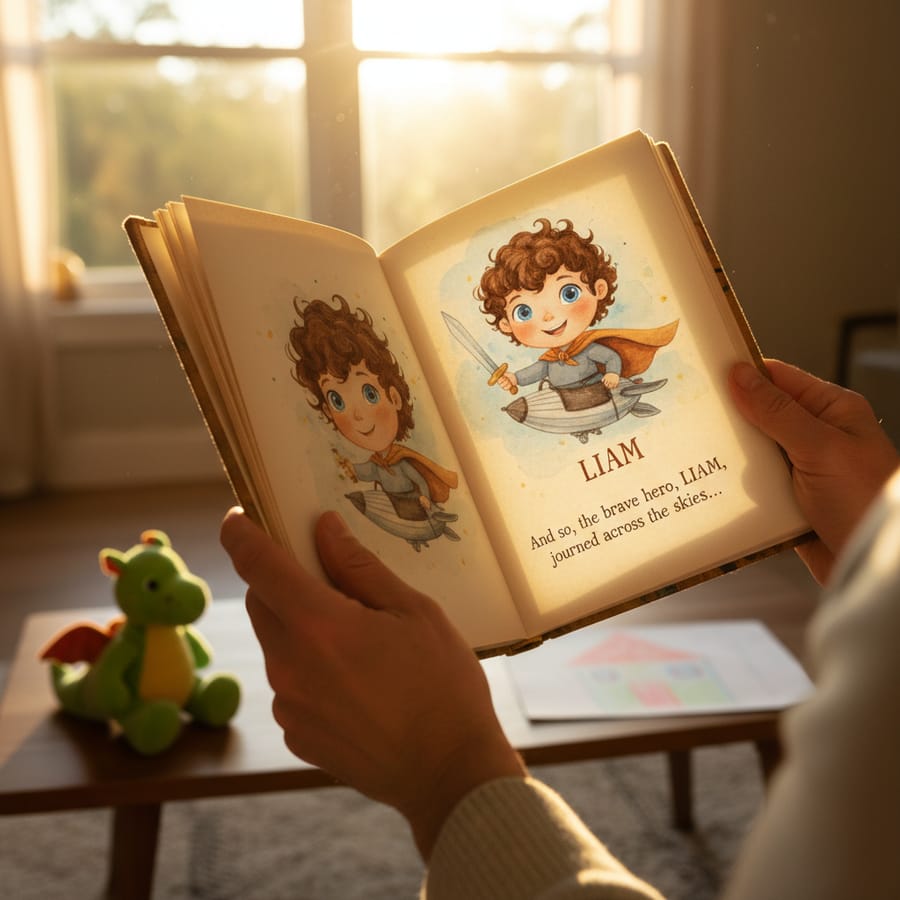
When you read personalized children's books with your little one, their brain isn't just processing a generic story about a random bear or a distant prince. Their brain is processing a story about them. When the hero of the book has your child’s name and, thanks to the AI technology at StorytimeHero.ai, your child’s uploaded photo, the brain goes into overdrive. It flags the information as "highly important."
Because the child is the protagonist, their "working memory" is more engaged. They aren't just passive observers; they are active participants. This active engagement helps move information from short-term memory into long-term storage. This is why a phrase like "Leo the Brave saved the day" sticks much better than "The knight saved the day." If your child is Leo, that phrase becomes a part of their self-identity and their permanent memory bank.
Using Repetition in Personalized Children's Books to Build Vocabulary
We’ve all been there: it’s 8:00 PM, you’re exhausted, and your child hands you the same book you’ve read every night for two weeks. Your first instinct might be to hide the book under the sofa, but there is a very good reason your child wants to hear it again. Repetition is the "weightlifting" of brain development.
In personalized children's books, repetition serves a dual purpose. First, it provides a sense of rhythm and predictability. Children crave routine because it makes the world feel safe. When they know exactly what phrase is coming next, it builds their confidence.
Second, repetition is how children master complex language. If a story uses a "big" word like extraordinary or courageous, hearing it once isn't enough. They need to hear it in context, multiple times, to truly own it. When that word is linked to their own actions in a story—like "Avery showed extraordinary kindness"—the repetition reinforces the meaning of the word through the lens of their own behavior.
By the tenth time you read that personalized phrase, your child isn't just memorizing sounds; they are connecting a complex concept to their own personality. This is one of the most effective benefits of reading to your child that you can find. It turns a simple bedtime routine into a high-octane vocabulary lesson.
Why Personalized Children's Books Create Stronger Emotional Bonds
Learning isn't just a cognitive process; it’s an emotional one. We remember things that make us feel something. This is why personalized children's books are so much more effective than standard stories. When a child sees their own face reacting to a dragon or helping a friend, it triggers an emotional response that generic illustrations simply can't match.
This emotional connection creates a "glue" for memory. When a child feels proud, excited, or even a little bit nervous alongside their "book self," their brain releases dopamine. Dopamine is a neurotransmitter that is closely linked to memory and focus. Essentially, the joy of seeing themselves as a hero makes their brain "record" the experience more vividly.
Furthermore, these books strengthen the bond between you and your child. When you sit down for personalized bedtime stories, you are sending a powerful message: "You are the hero of this story, and you are the center of my world." This feeling of being seen and valued creates a safe emotional space where learning can flourish. A child who feels secure and loved is a child whose brain is open and ready to absorb new information.
The Role of Visual Cues in Memory Retention
While the words are important, the visual aspect of a storybook is what captures a child's imagination first. For young children who aren't yet reading fluently, the pictures tell the story. This is where the AI-generated illustrations of StorytimeHero.ai change the game.
Most personalized books just swap out a name. But when a child sees a character that actually looks like them—their hair, their eyes, their smile—the level of "active encoding" increases. Active encoding is the process of taking sensory input and turning it into a lasting memory.
- Recognition: The child recognizes themselves instantly, which anchors their attention.
- Association: They associate the plot points with their own life experiences.
- Recall: Later, when they see their own face in a mirror, they might recall the "brave" or "kind" things they did in the book.
This visual repetition—seeing their face on every page—acts as a constant reminder that they are capable of the adventures described in the text. It bridges the gap between the fantasy of the book and the reality of their daily lives. You can learn more about how AI creates personalized books to see how this technology brings these visual cues to life.
Practical Tips to Make Personalized Phrases Stick
Knowing that personalization and repetition work is one thing, but how do you make the most of it during your nightly reading session? Here are some actionable tips to help those personalized phrases become a permanent part of your child’s vocabulary and self-image.
1. Use "Dialogic Reading"
Don't just read to your child; read with them. Ask questions that bridge the book and real life. If the book says, "Maya was a helpful hero," stop and ask, "Do you remember when you were a helpful hero today? You helped me pick up your blocks!" This reinforces the personalized phrase by connecting it to a real-world action.
2. Pause and Let Them Fill in the Blanks
Once you have read a personalized book a few times, start pausing before the key phrases. For example, say, "And then, the bravest person in the whole kingdom, [Pause]..." and let your child shout out their own name. This forces their brain to retrieve the information from memory, which is a much stronger form of learning than just hearing it.
3. Create a "Catchphrase"
If there is a particularly positive phrase in the book, like "Ben never gives up," start using it outside of storytime. When they are struggling with a puzzle or learning to tie their shoes, remind them of their hero self. "Remember what it says in your book? Ben never gives up!" This turns the book into a manual for life.
4. Mix Up the Tone
To keep repetition from becoming "white noise," try changing your voice. Read the personalized phrase in a whisper, then in a booming "hero" voice, then in a silly voice. This slight variation keeps the brain alert and prevents it from tuning out the familiar words.
5. Focus on the Illustrations
Spend time looking at the AI-generated pictures of your child. Ask them, "What is [Child's Name] doing here?" or "How do you think [Child's Name] feels in this picture?" This helps them process the visual information and strengthens the self-reference effect. For more ideas on how to use these books, check out our guide on building a reading habit.
Why This Matters for Long-Term Literacy
The goal of using personalized children's books isn't just to have a fun 15 minutes before bed. It’s about building the "literacy muscles" that will serve them for years to come. When a child has a positive, high-engagement experience with books early on, they are much more likely to become lifelong readers.
Repetition teaches them the mechanics of language—syntax, grammar, and phonics. Personalization teaches them the purpose of language—to tell stories, to express identity, and to connect with others. When these two things combine, reading stops being a chore or a school requirement. It becomes a source of joy and self-discovery.
By investing in a custom storybook gift, you are giving your child a tool that helps them understand who they are and what they are capable of. You are making the lessons of the story "stick" in a way that a generic book never could.
Frequently Asked Questions
How does personalization actually help with memory?
Personalization utilizes the "Self-Reference Effect," which is the brain's tendency to better encode and recall information that is related to oneself. When a child is the hero of the story, their brain treats the information as high-priority, leading to better long-term retention.
Is reading the same book every night actually good for my child?
Yes! Repetition is essential for cognitive development. It helps children master vocabulary, understand story structure, and gain the confidence that comes from being able to predict what happens next. In personalized books, this repetition also reinforces positive self-traits.
At what age do personalized books become effective?
Children as young as two can begin to recognize their own names and faces. However, the peak effectiveness for these books is usually between ages 3 and 8, when children are rapidly expanding their vocabulary and developing their sense of self-identity.
Can personalized books help children who are struggling to enjoy reading?
Absolutely. Many children struggle with reading because they don't feel a connection to the material. By putting the child at the center of the story with their own face and name, the "boredom barrier" is removed, making reading an exciting and personal experience.
What makes StorytimeHero.ai different from other personalized books?
Most personalized books only change the name or allow you to pick a generic avatar. StorytimeHero.ai uses advanced AI to incorporate your child’s uploaded photo into the illustrations. This creates a much deeper level of personalization and engagement, which significantly boosts memory and emotional connection.
Related Reading
- The Power of Seeing Yourself as the Hero
- How Personalized Stories Improve Toddler Vocabulary
- The Role of AI in Modern Children's Literature
- Why Bedtime Stories Are Essential for Brain Development
- Creating a Magical Reading Nook for Your Child
- How to Choose the Right Adventure for Your Child's Personality
- The Psychology of "Read it Again!": Why Kids Love Repetition
- StorytimeHero.ai: Transforming Screen Time into Story Time
Free preview checklist
Get the personalized book gift checklist
Know what photo to use, what to write in the dedication, and what to review before ordering.